
Masks, Gloves and Traceability: Why Iris Biometrics is the most reliable identification method in GMP environments
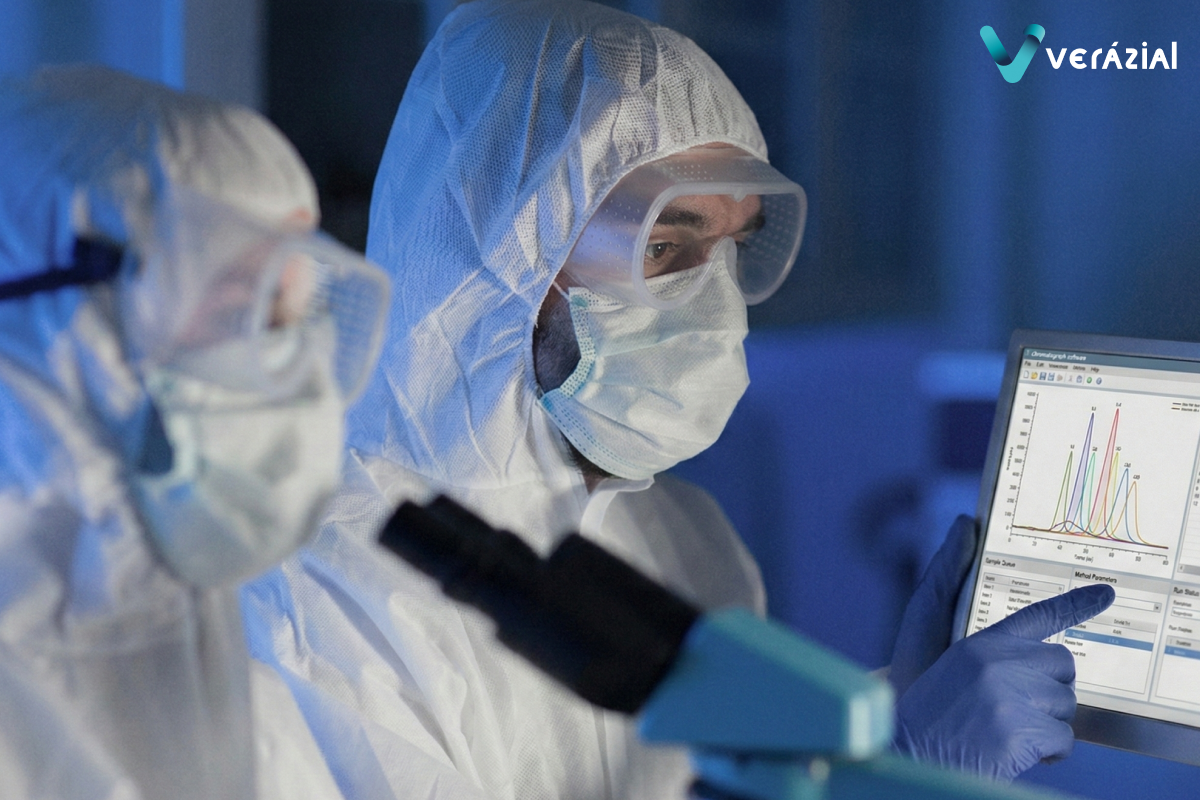
In GMP-regulated environments, ensuring reliable identification is essential to data integrity, compliance, and drug safety. However, cleanroom protocols require Personal Protective Equipment (PPE) such as masks and gloves, which significantly limit the effectiveness of traditional identification methods. Iris biometrics emerges as the most secure, contactless, and traceable solution, perfectly adapted to regulatory compliance.
From ALCOA+ to Annex 11: Why authentication is now a priority
Pharmaceutical manufacturing environments operate under strict regulatory frameworks such as EU GMP Annex 11, 21 CFR Part 11, and global data integrity guidance issued by authorities including the World Health Organization, U.S. Food and Drug Administration, and European Medicines Agency. These regulations emphasize that electronic records must be attributable, secure, and protected against unauthorized access.
At the same time, GMP production areas require operators to wear:
- Protective masks
- Protective goggles
- Gloves
- Hair covers
- Protective suits
These hygiene and contamination-control measures are non-negotiable. However, they create significant identification challenges.
The compliance risk of Passwords, Badges, and Shared credentials in cleanrooms
Fingerprint recognition becomes unreliable in cleanrooms because operators wear gloves at all times. Removing gloves to authenticate:
- Breaks contamination control protocols
- Increases operational delays
- Introduces hygiene risks
Facial recognition also presents limitations. Masks, protective glasses, and hair covers obscure key facial features required for reliable matching. Badges and passwords, still widely used in pharmaceutical facilities, introduce even greater risks:
- Shared credentials undermine accountability
- Lost or borrowed badges compromise traceability
- Password fatigue increases non-compliant practices
In GMP environments, where every action must be attributable to a specific individual, these weaknesses directly impact compliance with ALCOA+ principles.
For a broader discussion on biometric technologies and their strengths, you may also consult our article Multimodal Biometrics: Why combining Iris, Fingerprint, and Facial Recognition enhances security?
Biometrics as an integral solution for Data Traceability
Biometrics shifts identification from “what you know” or “what you have” to “who you are.” Among available modalities, iris recognition stands out as uniquely adapted to cleanroom conditions.
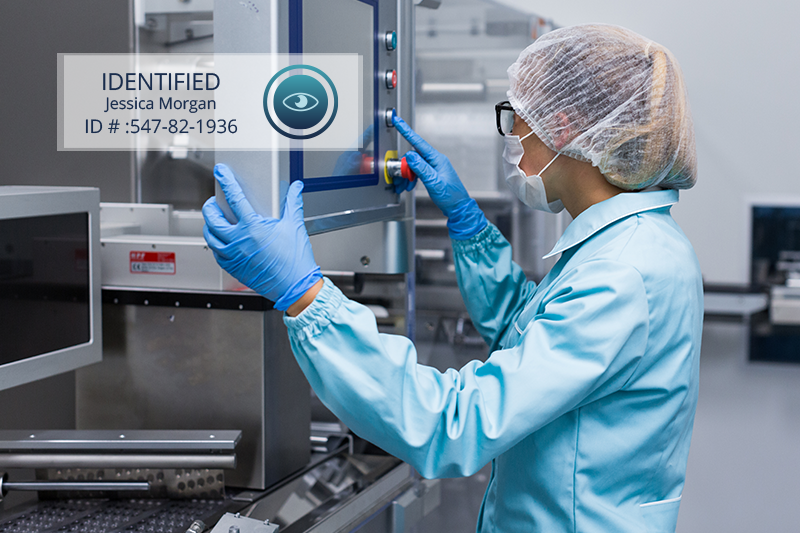
The iris is the colored ring around the pupil. Its pattern is highly complex and unique and remains stable throughout a person’s lifetime. Unlike fingerprints, iris recognition does not require physical contact. Unlike facial recognition, it does not depend on the lower half of the face. Even when an operator wears a mask, protective goggles, gloves or full cleanroom attire, the iris remains visible and measurable.
This makes iris biometrics particularly suitable for production areas, laboratories, and aseptic manufacturing environments.
Alignment with ALCOA+ and Data Integrity requirements
Regulatory authorities consistently emphasize that electronic records must be attributable and protected from unauthorized alteration. Iris authentication strengthens:
- Attributable – Each system action is linked to a unique individual.
- Accurate – Authentication errors are minimized.
- Complete & Consistent – Every login and action is logged automatically.
- Enduring & Available – Audit trails remain protected and traceable.
Because iris biometrics cannot be easily shared, forgotten, or transferred, it eliminates one of the most common quality inspection findings- shared user credentials.
You can also explore our article on Employees’ identification in the pharmaceutical industry according ALCOA+ to understand how biometric authentication reinforces compliance strategies.
Implementation of iris biometrics for Access and Electronic Signatures
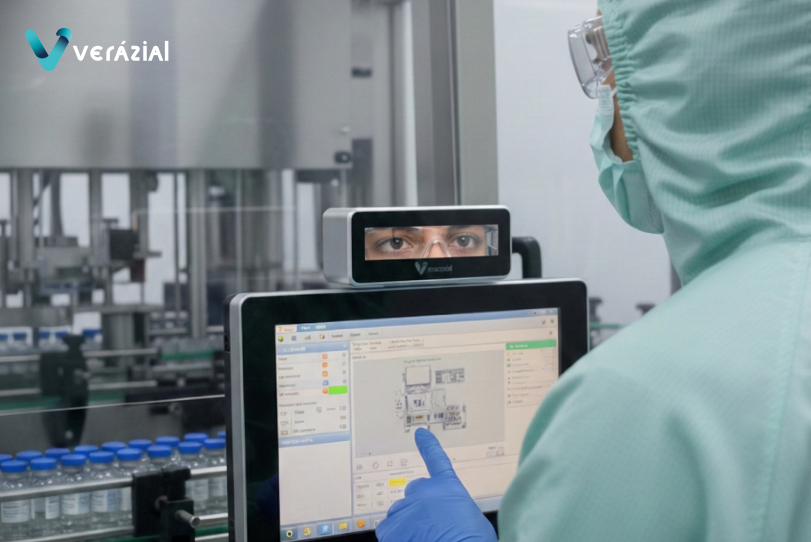
Implementing iris recognition in pharmaceutical environments requires proper validation, system integration, and alignment with existing quality and compliance frameworks. When deployed correctly, it delivers measurable improvements in data integrity, operational security, and regulatory defensibility while remaining fully compatible with regulatory requirements.
- Secure access to machinery and critical systems: Iris authentication can be integrated directly into manufacturing equipment, electronic batch record systems, MES and LIMS platforms, cleanroom entry points, and other high-risk production areas. By ensuring that only authorized and trained personnel can activate equipment, modify parameters, or carry out electronic signatures, each system interaction becomes uniquely attributable to a verified individual. This eliminates shared credentials, prevents unauthorized manipulation, and strengthens the organization’s position during regulatory inspections by providing clear, defensible audit trails.
- Contactless authentication in controlled environments: In aseptic production and sterile manufacturing settings, minimizing physical contact is essential to maintain contamination control. Iris recognition operates in a fully contactless manner, allowing operators to authenticate securely without removing masks or gloves. This preserves cleanroom integrity, reduces cross-contamination risks, and eliminates the operational delays associated with contact-based systems.
- Strengthened traceability and audit readiness: Traceability is central to regulatory compliance, and inspectors increasingly assess how effectively companies manage user access and audit trails. Biometric identification ensures that every login is individual and non-transferable, with each action securely time-stamped and recorded within the system. This level of authentication clarity simplifies deviation investigations, supports root cause analysis, and demonstrates robust control over electronic records.
- Reduced risk of human error and fraud: In regulated pharmaceutical environments, identification errors, whether accidental or intentional, can lead to batch rejection, regulatory findings, warning letters, or even product recalls. By eliminating password sharing and badge misuse, biometric verification significantly reduces the risk of unauthorized access and identity ambiguity. This reinforces accountability at every stage of production and protects both data integrity and patient safety.
- Improved operational efficiency: Beyond compliance and risk mitigation, iris biometrics enhances workflow efficiency. Authentication is faster than traditional password entry, and there is no need for password reset management or badge replacement. IT administrative workload is reduced, and operators spend less time managing credentials and more time focusing on production quality and operational performance.
Thus, trust in pharmaceutical manufacturing is demonstrated through measurable control over data integrity, traceability, accountability, regulatory compliance, and patient safety. In PPE-mandated environments, fingerprint and facial recognition technologies face practical limitations due to gloves and masks, creating potential identification gaps. Iris recognition remains reliable under these conditions, delivering accurate, contactless, and non-transferable authentication that aligns seamlessly with GMP and ALCOA+ requirements. As pharmaceutical manufacturing becomes increasingly digitalized and regulatory scrutiny intensifies, secure and unequivocal operator identification is no longer optional, it is a strategic compliance safeguard.
Strengthening Compliance through reliable Identification
In short, while masks and gloves are essential for contamination control in pharmaceutical manufacturing, they create significant challenges for traditional identification methods. Iris biometrics provides a secure, contactless, and highly reliable solution tailored to cleanroom constraints.
By implementing iris recognition, pharmaceutical organizations:
- Reinforce ALCOA+ compliance
- Strengthen data integrity
- Improve audit readiness
- Reduce operational risks
- Enhance overall traceability
Secure identification is not simply about controlling access; it is about protecting data, products, and ultimately patients.
Discover how iris Verázial ID for Pharma can be integrated into your pharma manufacturing plant to secure and streamline operations.
Contact us for a personalized assessment or request a demonstration tailored to your requirements.
References
- Images © Verázial Labs. All visuals are proprietary AI-generated assets created exclusively for this publication.
Masks, Gloves and Traceability: Why Iris Biometrics is the most reliable identification method in GMP environments
In GMP-regulated environments, ensuring reliable identification is essential to data integrity, compliance, and drug safety. However, cleanroom protocols require Personal Protective Equipment (PPE) such as masks and gloves, which significantly limit the effectiveness of traditional identification methods. Iris biometrics emerges as the most secure, contactless, and traceable solution, perfectly adapted to regulatory compliance.
From ALCOA+ to Annex 11: Why authentication is now a priority
Pharmaceutical manufacturing environments operate under strict regulatory frameworks such as EU GMP Annex 11, 21 CFR Part 11, and global data integrity guidance issued by authorities including the World Health Organization, U.S. Food and Drug Administration, and European Medicines Agency. These regulations emphasize that electronic records must be attributable, secure, and protected against unauthorized access.
At the same time, GMP production areas require operators to wear:
- Protective masks
- Protective goggles
- Gloves
- Hair covers
- Protective suits
These hygiene and contamination-control measures are non-negotiable. However, they create significant identification challenges.
The compliance risk of Passwords, Badges, and Shared credentials in cleanrooms
Fingerprint recognition becomes unreliable in cleanrooms because operators wear gloves at all times. Removing gloves to authenticate:
- Breaks contamination control protocols
- Increases operational delays
- Introduces hygiene risks
Facial recognition also presents limitations. Masks, protective glasses, and hair covers obscure key facial features required for reliable matching. Badges and passwords, still widely used in pharmaceutical facilities, introduce even greater risks:
- Shared credentials undermine accountability
- Lost or borrowed badges compromise traceability
- Password fatigue increases non-compliant practices
In GMP environments, where every action must be attributable to a specific individual, these weaknesses directly impact compliance with ALCOA+ principles.
For a broader discussion on biometric technologies and their strengths, you may also consult our article Multimodal Biometrics: Why combining Iris, Fingerprint, and Facial Recognition enhances security?
Biometrics as an integral solution for Data Traceability
Biometrics shifts identification from “what you know” or “what you have” to “who you are.” Among available modalities, iris recognition stands out as uniquely adapted to cleanroom conditions.
The iris is the colored ring around the pupil. Its pattern is highly complex and unique and remains stable throughout a person’s lifetime. Unlike fingerprints, iris recognition does not require physical contact. Unlike facial recognition, it does not depend on the lower half of the face. Even when an operator wears a mask, protective goggles, gloves or full cleanroom attire, the iris remains visible and measurable.
This makes iris biometrics particularly suitable for production areas, laboratories, and aseptic manufacturing environments.
Alignment with ALCOA+ and Data Integrity requirements
Regulatory authorities consistently emphasize that electronic records must be attributable and protected from unauthorized alteration. Iris authentication strengthens:
- Attributable – Each system action is linked to a unique individual.
- Accurate – Authentication errors are minimized.
- Complete & Consistent – Every login and action is logged automatically.
- Enduring & Available – Audit trails remain protected and traceable.
Because iris biometrics cannot be easily shared, forgotten, or transferred, it eliminates one of the most common quality inspection findings- shared user credentials.
You can also explore our article on Employees’ identification in the pharmaceutical industry according ALCOA+ to understand how biometric authentication reinforces compliance strategies.
Implementation of iris biometrics for Access and Electronic Signatures
Implementing iris recognition in pharmaceutical environments requires proper validation, system integration, and alignment with existing quality and compliance frameworks. When deployed correctly, it delivers measurable improvements in data integrity, operational security, and regulatory defensibility while remaining fully compatible with regulatory requirements.
- Secure access to machinery and critical systems: Iris authentication can be integrated directly into manufacturing equipment, electronic batch record systems, MES and LIMS platforms, cleanroom entry points, and other high-risk production areas. By ensuring that only authorized and trained personnel can activate equipment, modify parameters, or carry out electronic signatures, each system interaction becomes uniquely attributable to a verified individual. This eliminates shared credentials, prevents unauthorized manipulation, and strengthens the organization’s position during regulatory inspections by providing clear, defensible audit trails.
- Contactless authentication in controlled environments: In aseptic production and sterile manufacturing settings, minimizing physical contact is essential to maintain contamination control. Iris recognition operates in a fully contactless manner, allowing operators to authenticate securely without removing masks or gloves. This preserves cleanroom integrity, reduces cross-contamination risks, and eliminates the operational delays associated with contact-based systems.
- Strengthened traceability and audit readiness: Traceability is central to regulatory compliance, and inspectors increasingly assess how effectively companies manage user access and audit trails. Biometric identification ensures that every login is individual and non-transferable, with each action securely time-stamped and recorded within the system. This level of authentication clarity simplifies deviation investigations, supports root cause analysis, and demonstrates robust control over electronic records.
- Reduced risk of human error and fraud: In regulated pharmaceutical environments, identification errors, whether accidental or intentional, can lead to batch rejection, regulatory findings, warning letters, or even product recalls. By eliminating password sharing and badge misuse, biometric verification significantly reduces the risk of unauthorized access and identity ambiguity. This reinforces accountability at every stage of production and protects both data integrity and patient safety.
- Improved operational efficiency: Beyond compliance and risk mitigation, iris biometrics enhances workflow efficiency. Authentication is faster than traditional password entry, and there is no need for password reset management or badge replacement. IT administrative workload is reduced, and operators spend less time managing credentials and more time focusing on production quality and operational performance.
Thus, trust in pharmaceutical manufacturing is demonstrated through measurable control over data integrity, traceability, accountability, regulatory compliance, and patient safety. In PPE-mandated environments, fingerprint and facial recognition technologies face practical limitations due to gloves and masks, creating potential identification gaps. Iris recognition remains reliable under these conditions, delivering accurate, contactless, and non-transferable authentication that aligns seamlessly with GMP and ALCOA+ requirements. As pharmaceutical manufacturing becomes increasingly digitalized and regulatory scrutiny intensifies, secure and unequivocal operator identification is no longer optional, it is a strategic compliance safeguard.
Strengthening Compliance through reliable Identification
In short, while masks and gloves are essential for contamination control in pharmaceutical manufacturing, they create significant challenges for traditional identification methods. Iris biometrics provides a secure, contactless, and highly reliable solution tailored to cleanroom constraints.
By implementing iris recognition, pharmaceutical organizations:
- Reinforce ALCOA+ compliance
- Strengthen data integrity
- Improve audit readiness
- Reduce operational risks
- Enhance overall traceability
Secure identification is not simply about controlling access; it is about protecting data, products, and ultimately patients.
Discover how iris Verázial ID for Pharma can be integrated into your pharma manufacturing plant to secure and streamline operations.
Contact us for a personalized assessment or request a demonstration tailored to your requirements.
References
- Images © Verázial Labs. All visuals are proprietary AI-generated assets created exclusively for this publication.
Masks, Gloves and Traceability: Why Iris Biometrics is the most reliable identification method in GMP environments
In GMP-regulated environments, ensuring reliable identification is essential to data integrity, compliance, and drug safety. However, cleanroom protocols require Personal Protective Equipment (PPE) such as masks and gloves, which significantly limit the effectiveness of traditional identification methods. Iris biometrics emerges as the most secure, contactless, and traceable solution, perfectly adapted to regulatory compliance.
From ALCOA+ to Annex 11: Why authentication is now a priority
Pharmaceutical manufacturing environments operate under strict regulatory frameworks such as EU GMP Annex 11, 21 CFR Part 11, and global data integrity guidance issued by authorities including the World Health Organization, U.S. Food and Drug Administration, and European Medicines Agency. These regulations emphasize that electronic records must be attributable, secure, and protected against unauthorized access.
At the same time, GMP production areas require operators to wear:
- Protective masks
- Protective goggles
- Gloves
- Hair covers
- Protective suits
These hygiene and contamination-control measures are non-negotiable. However, they create significant identification challenges.
The compliance risk of Passwords, Badges, and Shared credentials in cleanrooms
Fingerprint recognition becomes unreliable in cleanrooms because operators wear gloves at all times. Removing gloves to authenticate:
- Breaks contamination control protocols
- Increases operational delays
- Introduces hygiene risks
Facial recognition also presents limitations. Masks, protective glasses, and hair covers obscure key facial features required for reliable matching. Badges and passwords, still widely used in pharmaceutical facilities, introduce even greater risks:
- Shared credentials undermine accountability
- Lost or borrowed badges compromise traceability
- Password fatigue increases non-compliant practices
In GMP environments, where every action must be attributable to a specific individual, these weaknesses directly impact compliance with ALCOA+ principles.
For a broader discussion on biometric technologies and their strengths, you may also consult our article Multimodal Biometrics: Why combining Iris, Fingerprint, and Facial Recognition enhances security?
Biometrics as an integral solution for Data Traceability
Biometrics shifts identification from “what you know” or “what you have” to “who you are.” Among available modalities, iris recognition stands out as uniquely adapted to cleanroom conditions.
The iris is the colored ring around the pupil. Its pattern is highly complex and unique and remains stable throughout a person’s lifetime. Unlike fingerprints, iris recognition does not require physical contact. Unlike facial recognition, it does not depend on the lower half of the face. Even when an operator wears a mask, protective goggles, gloves or full cleanroom attire, the iris remains visible and measurable.
This makes iris biometrics particularly suitable for production areas, laboratories, and aseptic manufacturing environments.
Alignment with ALCOA+ and Data Integrity requirements
Regulatory authorities consistently emphasize that electronic records must be attributable and protected from unauthorized alteration. Iris authentication strengthens:
- Attributable – Each system action is linked to a unique individual.
- Accurate – Authentication errors are minimized.
- Complete & Consistent – Every login and action is logged automatically.
- Enduring & Available – Audit trails remain protected and traceable.
Because iris biometrics cannot be easily shared, forgotten, or transferred, it eliminates one of the most common quality inspection findings- shared user credentials.
You can also explore our article on Employees’ identification in the pharmaceutical industry according ALCOA+ to understand how biometric authentication reinforces compliance strategies.
Implementation of iris biometrics for Access and Electronic Signatures
Implementing iris recognition in pharmaceutical environments requires proper validation, system integration, and alignment with existing quality and compliance frameworks. When deployed correctly, it delivers measurable improvements in data integrity, operational security, and regulatory defensibility while remaining fully compatible with regulatory requirements.
- Secure access to machinery and critical systems: Iris authentication can be integrated directly into manufacturing equipment, electronic batch record systems, MES and LIMS platforms, cleanroom entry points, and other high-risk production areas. By ensuring that only authorized and trained personnel can activate equipment, modify parameters, or carry out electronic signatures, each system interaction becomes uniquely attributable to a verified individual. This eliminates shared credentials, prevents unauthorized manipulation, and strengthens the organization’s position during regulatory inspections by providing clear, defensible audit trails.
- Contactless authentication in controlled environments: In aseptic production and sterile manufacturing settings, minimizing physical contact is essential to maintain contamination control. Iris recognition operates in a fully contactless manner, allowing operators to authenticate securely without removing masks or gloves. This preserves cleanroom integrity, reduces cross-contamination risks, and eliminates the operational delays associated with contact-based systems.
- Strengthened traceability and audit readiness: Traceability is central to regulatory compliance, and inspectors increasingly assess how effectively companies manage user access and audit trails. Biometric identification ensures that every login is individual and non-transferable, with each action securely time-stamped and recorded within the system. This level of authentication clarity simplifies deviation investigations, supports root cause analysis, and demonstrates robust control over electronic records.
- Reduced risk of human error and fraud: In regulated pharmaceutical environments, identification errors, whether accidental or intentional, can lead to batch rejection, regulatory findings, warning letters, or even product recalls. By eliminating password sharing and badge misuse, biometric verification significantly reduces the risk of unauthorized access and identity ambiguity. This reinforces accountability at every stage of production and protects both data integrity and patient safety.
- Improved operational efficiency: Beyond compliance and risk mitigation, iris biometrics enhances workflow efficiency. Authentication is faster than traditional password entry, and there is no need for password reset management or badge replacement. IT administrative workload is reduced, and operators spend less time managing credentials and more time focusing on production quality and operational performance.
Thus, trust in pharmaceutical manufacturing is demonstrated through measurable control over data integrity, traceability, accountability, regulatory compliance, and patient safety. In PPE-mandated environments, fingerprint and facial recognition technologies face practical limitations due to gloves and masks, creating potential identification gaps. Iris recognition remains reliable under these conditions, delivering accurate, contactless, and non-transferable authentication that aligns seamlessly with GMP and ALCOA+ requirements. As pharmaceutical manufacturing becomes increasingly digitalized and regulatory scrutiny intensifies, secure and unequivocal operator identification is no longer optional, it is a strategic compliance safeguard.
Strengthening Compliance through reliable Identification
In short, while masks and gloves are essential for contamination control in pharmaceutical manufacturing, they create significant challenges for traditional identification methods. Iris biometrics provides a secure, contactless, and highly reliable solution tailored to cleanroom constraints.
By implementing iris recognition, pharmaceutical organizations:
- Reinforce ALCOA+ compliance
- Strengthen data integrity
- Improve audit readiness
- Reduce operational risks
- Enhance overall traceability
Secure identification is not simply about controlling access; it is about protecting data, products, and ultimately patients.
Discover how iris Verázial ID for Pharma can be integrated into your pharma manufacturing plant to secure and streamline operations.
Contact us for a personalized assessment or request a demonstration tailored to your requirements.
References
- Images © Verázial Labs. All visuals are proprietary AI-generated assets created exclusively for this publication.
You May Also Like


You May Also Like